





By Mercedes Quintanilla
A well-designed office does more than support work: it creates conditions that help people focus, collaborate, and perform at their best.
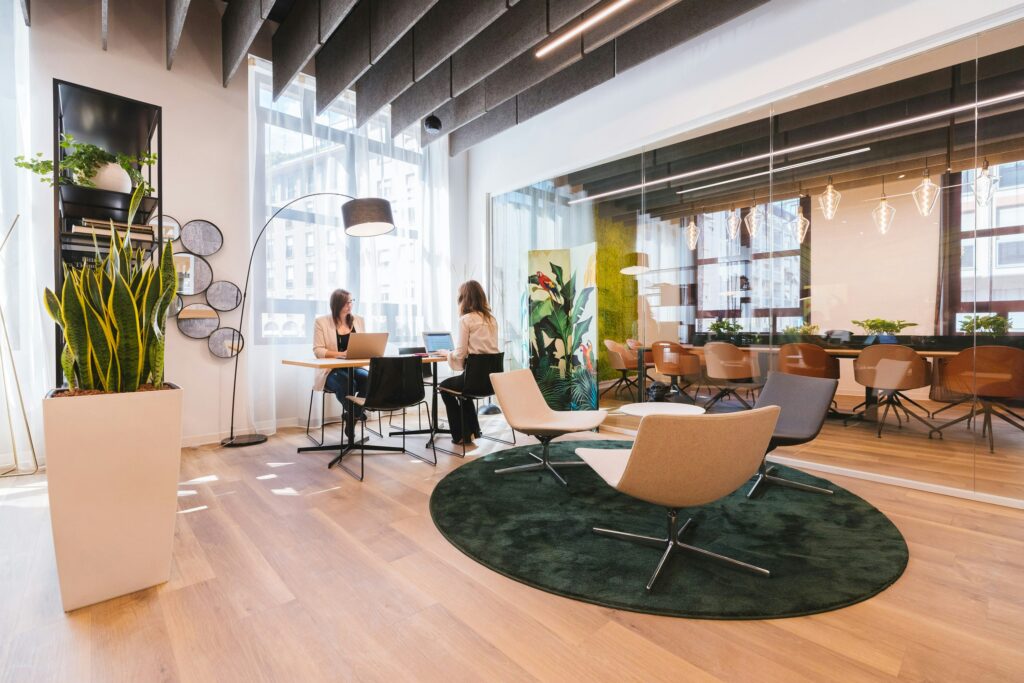
Biophilic design integrates nature into corporate environments through decisions that go beyond adding plants. Natural light, outdoor views, materials, textures, and connections to green spaces can enrich the experience of the workplace and contribute to the well-being of the people who use it.
From a human-centered perspective, the goal is to create environments that respond to both employee needs and organizational objectives.
Key Strategies for Biophilic Design
- Natural light and outdoor views: Make the most of natural lighting and visual connections to the outdoors while managing glare and heat gain.
- Integration of outdoor areas: Connect terraces, courtyards, and gardens with interior spaces to provide alternatives for breaks and interaction.
- Intentional color selection: Use color according to the function of the space, its visual identity, and the experience the design aims to create.
- Natural materials and textures: Incorporate wood, stone, and other surfaces that enrich the sensory experience while considering durability and maintenance.
- Vegetation integrated into the design: Select plants and locations based on lighting, ventilation, and maintenance requirements.
- Human-centered design: Combine these strategies with ergonomics, mobility, comfort, and spaces that support different needs for focus and collaboration.

Benefits of Biophilic Design in Corporate Offices
- Organizational performance: A well-planned environment can contribute to a better workplace experience and support organizational objectives.
- Focus and attention: Appropriate lighting, natural views, and well-organized spaces can support the conditions needed for tasks that require concentration.
- Employee well-being: Access to nature and suitable environmental conditions can contribute to a more positive perception of the workplace.
- Creativity and collaboration: Diverse spaces with outdoor connections and areas for different activities can facilitate new forms of interaction.
- Employee experience and retention: An environment that responds to people’s needs can contribute to a more satisfying work experience, although retention also depends on other organizational factors.
Return on Investment (ROI) Through Biophilic Design
The impact of design on an organization can be evaluated beyond the appearance of its spaces. Personnel costs account for a significant portion of business expenses, so even small improvements in certain operational indicators can have financial relevance.
Consider the following illustrative example:
- Total annual expenses: $4,583,232 USD
- Annual personnel costs: $3,190,225 USD
If an organization achieved a 3% improvement in its personnel costs, the potential savings would be approximately $95,707 per year.
This figure is a mathematical projection based on the stated assumption, not a guarantee of savings attributable to biophilic design. To determine the actual return, implementation costs would need to be evaluated and indicators such as absenteeism, satisfaction, performance, and retention measured before and after the interventions.
The opportunity lies in connecting design decisions to concrete organizational objectives and measurable outcomes.
Designing Offices with Intention
At Mercedes Quintanilla Design Studio (MQDS), we understand that the workplace environment influences people’s everyday experiences. Every decision should therefore serve a purpose: supporting concentration, facilitating collaboration, improving comfort, and creating spaces that align with the team’s needs.
Biophilic design is neither a standalone solution nor a guarantee of results. It is a strategy that, when integrated with spatial planning, ergonomics, and environmental performance, can contribute to better workplace experiences.
When design responds to people and business objectives, the workplace becomes more than a place to work. It becomes a strategic tool for the organization.


Read the Comments +